Ohayō Gozaimasu from me in chilly Tokyo – the temperature has dropped about 10 degrees in the last few weeks, and it won’t be long before my coat and scarf are accompanied by gloves and wooly hat!
Just a short post about the Kiku Matsuri (the Japanese Chrysanthemum Flower Festival). All over the place we were seeing stalls of these amazing flowers and wondered what they were in aid of. We first saw them at a temple near the Imperial Palace gardens, then again outside a local government building. There were some halfway up the hill on Enoshima island, and this weekend we saw more at temples in the Kamakura area. After this floral abundance, I did some research into the flowers, spurred on by the vast knowledge of the old man I met at one of the stalls.
The kiku was brought to Japan from China, and over hundreds of years it has been improved upon and developed by dedicated gardeners. The flower became very popular, particularly with the Japanese royal family who incorporated the chrysanthemum into their family crest. You can see this ‘mon’ decorating the doors of temples all over the city, and it always reminds me of the Chinese film Curse of the Golden Flower where the Empress embroiders a golden chrysanthemum onto thousands of scarves as gifts for the soldiers who, with her son, lead a rebellion against her evil husband. (It’s an excellent film - if you haven’t seen it, I highly recommend it!)
The Kiku Matsuri usually happens around mid-November, though we’ve been seeing examples of local competitions for weeks. There are many different varieties of the Kiku, and for the competition, each type must be grown in a certain way and to a strict specification. The most popular type of Kiku we saw was the atsumono type, which has a single flower at the end of each stem. This is produced by ‘disbudding’ and removing all other flower buds as it grows, so that on stem may produce only one flower. In the competition, the atsumono type is presented as a trio, with each flower at exactly the same height as its companions. At the base, it looked as if the three stems had sprung from one origin, but on reflection I concluded that the three stems had probably grown separately and later been bound together for a more appealing base. The head of the flower is large, spanning up to 20cm across. The three flowers are said to act as a balance to each other, and according the Chinese belief, each has a different meaning - heaven, earth, and human. All the elements are important and must be equal, which is why the kiku is grown so the flowers are all of the same height. At the display near my local government building, I met a volunteer who was watching over the flowers who told me much information about them. I can’t quite remember the exact height, but I think he said that for the atsumono kiku, entries must be between 100 and 120 cm tall.
He was such a lovely gentleman, speaking excellent English and being very knowledgeable on his subject. At 71 years old, he told me that he now devotes much of his time to growing the beautiful flowers – but it’s no walk in the park. He claimed that “Raising a beautiful kiku is more difficult than raising my children! When your child is hungry, they ask for food. Or when they are thirsty, they ask for water. But with a kiku, they cannot tell you what they want, so you have to guess, and know what they will need!” He showed us the winning entry of that kiku matsuri – a stunning atsumono variety, its petals thick and dense, a perfect snowy white.
My favourite variety is the kudamono kiku, which is known in the west as the ‘spider chrysanthemum’. The petals of this type are long and thin, with shorter petals and the top that increase in length as they get nearer the stem, fanning out like a lions mane. Smaller than the atsumono variety, they span 15cm across the head. I particularly liked the multi-coloured ones, with colours bleeding into each other from the centre outwards. (Photo below)
The cascading style kiku were also stunning, particularly the kengaizukuri, meaning ‘overhanging cliff form’. According to a helpful article I found: In this case a single plant is trained onto a flat, slightly arching bamboo lattice structure varying in size, but typically two meter long, pointed at one end and swelling to a meter across at the centre. The entire lattice is positioned so that it dips on the pointed end, creating the cascading effect. I also saw many examples of the bonsai forms, which were very cute and had obviously had a lot of hard work put into them.
While my knowledge of flowers is pretty limited, I found the kiku a wonderful research subject and, of course, a visual joy. As we are slap bang in the middle of November, I’m looking forward to seeing more of the lovely Japanese chrysanthemums on my travels around Tokyo. If you want to learn more about the Kiku きく, visit this website that explains pretty much everything you could want to know about them: http://botanyboy.org/a-japanese-chyrsanthemum-flower-festival-kiku-matsuri/
Sayonara for now!
Welcome to The Travelling Bee's blog. I am a TEFL teacher living and working in Kumamoto (Japan), and this is where I blog about my experiences of life abroad. While this blog only displays posts from the last few months, I have been working as a TEFL teacher for years, and am currently working on my first travel book.
pic
Monday, 17 November 2014
Saturday, 15 November 2014
Working at an International Kindergarten in Tokyo
Kon'nichiwa!
A few days after arriving in Japan I secured interviews at various schools in Tokyo, and a few days after that I was offered a job. Finding a job here was much easier than I thought it would be, though I get the feeling that my luck was down to living in such a big city – finding work elsewhere in the country will not be so easy.
I’m currently working at an International Kindergarten. The vast majority of the students are Japanese, though we have a few kids who are half American, and a number of Chinese children in the baby classes. The school, and my job, is split into different sections. In the main school, there is the kinder class (3-5 years old) with about 30 kids enrolled and the pre-kinder class (2-4 years old) which has about 20 kids. In the little school, there are three classes. The 2 year old class (2-4 years) has about 20 kids, the 1 year olds class has about 15 kids, and the baby class (under 1 year) has about 12 kids. I also have one off-site class a week, which has kids of anything from 2 to 5 years. So basically my age range is 5 months to 5 years.
In the off-site class, I act as an assistant teacher in a eurhythmics class. Also known as the Dalcroze Method, it was developed in the early 20th century by Swiss musician and educator Émile Jaques-Dalcroze. In eurhythmics class, what we teach are the concepts of rhythm, structure, and musical expression using movement. It’s all a bit crazy, but lots of fun. Basically, the music teacher sits at the piano and plays music for most of the class, and I encourage the kids to jump around and do whatever it is they are meant to be doing… which I need to learn, like, on the spot. My first day, the teacher asked me:
“Have you ever taught eurhythmics before?”
“No.”
“Oh, can you play the piano?”
“No, but I used to play the flute a long time ago.”
“Ok, so you can read music?”
“No… not really.”
So, yeah – it’s been a bit of a challenge! Luckily I’m a fast learner and despite not really knowing anything about the art of creating music, I’ve managed to pick things up as we go along. When the music teacher plays different sorts of music, it’s a signal to the students to do a different action. For example, there is a different tune for running, walking, skipping, slow walking, tumbling to the floor, etc. If the teacher plays a minor scale (which, until a month ago, I wouldn’t have been able to tell from a major scale to save my life) then they have to walk backwards instead of forwards.
Sometimes we play a game where they have to listen to the music and do the action in a high or low way. When they were learning the fruit vocabulary, they had to pretend they were picking fruit from the tree, and when the teacher played a high note, they had to reach up high and pick from there, and a low note signified that they should pick from the ground. Its good fun, but exhausting! Sometimes I have 3 classes over a 2 hour slots, and most of that time I spent hopping around like a buffoon, so I’m knackered when class is out. But it’s just once a week so I can’t complain.
I spend most of my time at the main school, but usually I go to the little school for an hour each day. At the little school I teach one class a week – 30 minutes to the 2 year old class. Most of them can’t speak any English at all, and as there are so many of them to control at once that I just try and get the majority of them to say a few words over the lesson – just basic things like emotions, colours, numbers etc. All my other time at the little school is spent reading story books, or hanging out with the kids during ‘free play’ time. This is the best – I just sit on the floor and the kids come over and pile all their toys up on me.
With the bigger ones (2 years old) they are always competing for my attention. Because of this, I’ve learnt the Japanese for ‘look’ (Mite - 見て) because the kids will parade in front of me while pulling a funny face, doing a dance or demonstrating a karate move saying “look! look!” to show off. In the baby class, the kids range from 5 months to just under a year, and from time to time I read them a book, but most of all I just try to engage with them without having them burst into tears. There is one little girl who says hello to me, and a few who will tolerate my presence in the classroom but won’t come to play with me. Of course, there are a few who just cry every time they see me – at only a few months old, they’ve had limited experiences with foreigners and don’t quite know what to make of me. The smallest ones can’t walk or crawl yet, and when I hold them I do so with them facing away from me, so they can’t see that they’re being held by the ‘scary white girl’.
However, most of my time at work is spent in the Kids house, with the 3-5 year olds. Their English, for the most part, is excellent. They come out with things like “My favourite colour is sky blue”, “The potato tastes good because it’s salty”, “Do you think I’ve drawn a window on my rocket? It’s not – it’s an aquarium!” and “The fish in this picture is poisonous so please be careful, don’t touch it!”
The schedule at school is rarely stuck to, and English lessons happen sporadically. Sometimes I teach two or three classes a day (30 minutes each) and sometimes I won’t teach a class for days on end. I supervise at lunchtime, snack time and nap time, and the rest of my working hours are just helping out with whatever else is going on – Montessori class, free play, going for walks, dance class… I just sort of go with the flow. I also have to teach a 30 minute ‘parent class’ once a week (which is a major joke because their toddlers are in the classroom with us so we get very little done), and a 1 hour ‘staff class’ once a week with some of the staff who speak less English than the kids. I don’t like teaching adults and this is pretty much the worst hour of my week – especially given that I did specifically say when I was interviewed that I didn’t want to teach adults… but there we go. It doesn’t matter where in the world you work – people will tell you lies to make you sign a contract.
So that’s my working life. I’ve been working at the Kindergarten for over a month now, and already I’m starting to look for a new job as I know we won’t be here in Tokyo for much longer. Ideally I’d like to be working somewhere with more structure and regularity to the English classes, with materials and a curriculum rather than ‘just teach whatever you want’. So we’ll see. But for now it pays the bills and I enjoy being with the kids – even when they’re coughing and sneezing in my face so I’ve got the lurgy too. I’ve been putting off posting this for ages as I wanted some pictures to go with it. But after asking each of my managers three times to email me the pictures they took at school recently, I’ve given up on every getting copies of those!
Sayonara for now!
A few days after arriving in Japan I secured interviews at various schools in Tokyo, and a few days after that I was offered a job. Finding a job here was much easier than I thought it would be, though I get the feeling that my luck was down to living in such a big city – finding work elsewhere in the country will not be so easy.
I’m currently working at an International Kindergarten. The vast majority of the students are Japanese, though we have a few kids who are half American, and a number of Chinese children in the baby classes. The school, and my job, is split into different sections. In the main school, there is the kinder class (3-5 years old) with about 30 kids enrolled and the pre-kinder class (2-4 years old) which has about 20 kids. In the little school, there are three classes. The 2 year old class (2-4 years) has about 20 kids, the 1 year olds class has about 15 kids, and the baby class (under 1 year) has about 12 kids. I also have one off-site class a week, which has kids of anything from 2 to 5 years. So basically my age range is 5 months to 5 years.
In the off-site class, I act as an assistant teacher in a eurhythmics class. Also known as the Dalcroze Method, it was developed in the early 20th century by Swiss musician and educator Émile Jaques-Dalcroze. In eurhythmics class, what we teach are the concepts of rhythm, structure, and musical expression using movement. It’s all a bit crazy, but lots of fun. Basically, the music teacher sits at the piano and plays music for most of the class, and I encourage the kids to jump around and do whatever it is they are meant to be doing… which I need to learn, like, on the spot. My first day, the teacher asked me:
“Have you ever taught eurhythmics before?”
“No.”
“Oh, can you play the piano?”
“No, but I used to play the flute a long time ago.”
“Ok, so you can read music?”
“No… not really.”
So, yeah – it’s been a bit of a challenge! Luckily I’m a fast learner and despite not really knowing anything about the art of creating music, I’ve managed to pick things up as we go along. When the music teacher plays different sorts of music, it’s a signal to the students to do a different action. For example, there is a different tune for running, walking, skipping, slow walking, tumbling to the floor, etc. If the teacher plays a minor scale (which, until a month ago, I wouldn’t have been able to tell from a major scale to save my life) then they have to walk backwards instead of forwards.
Sometimes we play a game where they have to listen to the music and do the action in a high or low way. When they were learning the fruit vocabulary, they had to pretend they were picking fruit from the tree, and when the teacher played a high note, they had to reach up high and pick from there, and a low note signified that they should pick from the ground. Its good fun, but exhausting! Sometimes I have 3 classes over a 2 hour slots, and most of that time I spent hopping around like a buffoon, so I’m knackered when class is out. But it’s just once a week so I can’t complain.
I spend most of my time at the main school, but usually I go to the little school for an hour each day. At the little school I teach one class a week – 30 minutes to the 2 year old class. Most of them can’t speak any English at all, and as there are so many of them to control at once that I just try and get the majority of them to say a few words over the lesson – just basic things like emotions, colours, numbers etc. All my other time at the little school is spent reading story books, or hanging out with the kids during ‘free play’ time. This is the best – I just sit on the floor and the kids come over and pile all their toys up on me.
With the bigger ones (2 years old) they are always competing for my attention. Because of this, I’ve learnt the Japanese for ‘look’ (Mite - 見て) because the kids will parade in front of me while pulling a funny face, doing a dance or demonstrating a karate move saying “look! look!” to show off. In the baby class, the kids range from 5 months to just under a year, and from time to time I read them a book, but most of all I just try to engage with them without having them burst into tears. There is one little girl who says hello to me, and a few who will tolerate my presence in the classroom but won’t come to play with me. Of course, there are a few who just cry every time they see me – at only a few months old, they’ve had limited experiences with foreigners and don’t quite know what to make of me. The smallest ones can’t walk or crawl yet, and when I hold them I do so with them facing away from me, so they can’t see that they’re being held by the ‘scary white girl’.
However, most of my time at work is spent in the Kids house, with the 3-5 year olds. Their English, for the most part, is excellent. They come out with things like “My favourite colour is sky blue”, “The potato tastes good because it’s salty”, “Do you think I’ve drawn a window on my rocket? It’s not – it’s an aquarium!” and “The fish in this picture is poisonous so please be careful, don’t touch it!”
The schedule at school is rarely stuck to, and English lessons happen sporadically. Sometimes I teach two or three classes a day (30 minutes each) and sometimes I won’t teach a class for days on end. I supervise at lunchtime, snack time and nap time, and the rest of my working hours are just helping out with whatever else is going on – Montessori class, free play, going for walks, dance class… I just sort of go with the flow. I also have to teach a 30 minute ‘parent class’ once a week (which is a major joke because their toddlers are in the classroom with us so we get very little done), and a 1 hour ‘staff class’ once a week with some of the staff who speak less English than the kids. I don’t like teaching adults and this is pretty much the worst hour of my week – especially given that I did specifically say when I was interviewed that I didn’t want to teach adults… but there we go. It doesn’t matter where in the world you work – people will tell you lies to make you sign a contract.
So that’s my working life. I’ve been working at the Kindergarten for over a month now, and already I’m starting to look for a new job as I know we won’t be here in Tokyo for much longer. Ideally I’d like to be working somewhere with more structure and regularity to the English classes, with materials and a curriculum rather than ‘just teach whatever you want’. So we’ll see. But for now it pays the bills and I enjoy being with the kids – even when they’re coughing and sneezing in my face so I’ve got the lurgy too. I’ve been putting off posting this for ages as I wanted some pictures to go with it. But after asking each of my managers three times to email me the pictures they took at school recently, I’ve given up on every getting copies of those!
Sayonara for now!
Monday, 10 November 2014
The Edo-Tokyo Museum
Ohayou Gozaimasu (good morning) from the Traveling Bee, who has had a cold for more than two weeks now and as such has been an idle blogger. But I have much to write about, so much so that I can’t write it in chronological order because I’ve forgotten the names of the places we visited! I’ll have to wait for Sasha to come home and ask him the names of the places we went to. So for now, let me introduce to you the Edo-Tokyo Museum.
Located near the Ryogoku Subway station (lines JR Sobu and Toei Oedo) we went at the right time because the museum is about to close for several months. An adult ticket is 600 Yen (£3.30), not including the special exhibitions. On entry to the museum, you cross over a large bridge which divides the cavernous hall. Most of the artefacts and exhibits are from ancient Tokyo (or Edo, as it was known until 1868).
As I hoped, in the style of East Asian museums, there were many scale models throughout the museum that were strewn with little characters going about their daily lives. We also saw several ‘light shows’ as we had seen in China, where the model has a film projected onto it in such a way that it looks like real people are walking around the scene. The Japanese visitors to the museum crowded round these as the curtains drew back, with much ooh-ing and ahh-ing as the show commenced.
One of the first replicas I saw was of a kago – a sort of Japanese sedan chair. Though saying that, a true kago litter was much more primitive – more like a hammock on a movable tree than the regal sedan chairs of Henry VIII’s England. The one in the Edo-Tokyo museum was laid on the floor for people to try out, and had a door on a shutter which slid back and forth. It was mainly children in the queue to have a go, but as I walked past there was a Grandma inside who was very much enjoying the experience.
My favourite artefact was an old lacquer writing table and an ink stone in a decorated lacquer box. I’m not a fan of the Chinese red lacquer, with its garish colouring and harsh smell that seems so much more prominent in the crimson dyed paint. However, the Japanese lacquer work was hugely tasteful, with details in gold on black. The ink stone case was embellished with an impression of Mt. Yoshino, and the writing table depicted a wiry river winding its way through a landscape of gnarled branches. Other relics included intricately painted folding screens, pottery, statues and an array of numismatic items.
The museum ranks highly with me because there were a number of ‘hands on’ opportunities, like the kago litter. There was a section in the museum dedicated to the history of the Edo fire brigade. Japan's first fire service was founded in 1629 during the Edo era, and was called Hikeshi. There was a standard of the brigade, less of a flag and more of an octopus-on-a-stick. The long tassels, when swung around, make the totem look like a flailing sea creature or furious dragon. There was an example of the standard suspended from the ceiling which you could try and lift – it was too heavy for me; I can’t imagine carrying that around when there’s a fire afoot. Sasha had a go, and also tried lifting the ‘night soil’ buckets suspended on a carrying pole, laden with… something… to the weight of 25kg.
Other sections of the museum I enjoyed were the section on child rearing (in ancient times, it was popular to give birth while seated rather than lying down), and the section on printing and publishing. There were a series of sheets showing how a picture was printed by doing the colours and details one layer at a time. While woodblock printing had been around in China since the early date of 764, it was not widely adopted in Japan until the 1600’s.
Another favourite piece of mine in the museum was the ‘sea clogs’ – basically stilts that you strapped to your feet for when you were ‘working in the sea’. The smaller pair were under a meter in height, but the taller ones were almost as tall as me.
At the end of the ancient section of the museum, there was a part on modern Japan, with a special exhibition on its technology. By this point in our tour we were quite tired and zipped around the exhibition without much interest (for me at least, not being fascinated by technology.) There was also a bit about the 2020 Tokyo Olympics, which I’m sure will be an exciting event. Actually, now is a great time to be an English teacher in Tokyo – the government is having a big drive to get people to learn English in time for the Olympics. Speaking of Olympics in Japan, do you know the origins of the male and female signs for public toilets? As part of the preparations for the 1964 Tokyo Olympics, Japan created over 40 different pictograms such as the internationally recognised pictograms for male and female toilets. They were not only used during the Olympics but became internationally adopted across the world. Fact of the day.
So that’s the Edo-Tokyo Museum. I’m glad we went before the museum closes for repair works, it would have been a shame to miss such an informative and fun outing. Other blogs to look forward to – our trip to the garden of the Imperial Palace, our sunny day trip to Edoshima island, the Kiku Festival, Japanese toilets and my working life. Yay!
Sayonara for now.
Oh, and to end it all off - a photo of an old telephone box from the museum, which shall henceforth be known as the Japanese Tardis.
Located near the Ryogoku Subway station (lines JR Sobu and Toei Oedo) we went at the right time because the museum is about to close for several months. An adult ticket is 600 Yen (£3.30), not including the special exhibitions. On entry to the museum, you cross over a large bridge which divides the cavernous hall. Most of the artefacts and exhibits are from ancient Tokyo (or Edo, as it was known until 1868).
As I hoped, in the style of East Asian museums, there were many scale models throughout the museum that were strewn with little characters going about their daily lives. We also saw several ‘light shows’ as we had seen in China, where the model has a film projected onto it in such a way that it looks like real people are walking around the scene. The Japanese visitors to the museum crowded round these as the curtains drew back, with much ooh-ing and ahh-ing as the show commenced.
One of the first replicas I saw was of a kago – a sort of Japanese sedan chair. Though saying that, a true kago litter was much more primitive – more like a hammock on a movable tree than the regal sedan chairs of Henry VIII’s England. The one in the Edo-Tokyo museum was laid on the floor for people to try out, and had a door on a shutter which slid back and forth. It was mainly children in the queue to have a go, but as I walked past there was a Grandma inside who was very much enjoying the experience.
My favourite artefact was an old lacquer writing table and an ink stone in a decorated lacquer box. I’m not a fan of the Chinese red lacquer, with its garish colouring and harsh smell that seems so much more prominent in the crimson dyed paint. However, the Japanese lacquer work was hugely tasteful, with details in gold on black. The ink stone case was embellished with an impression of Mt. Yoshino, and the writing table depicted a wiry river winding its way through a landscape of gnarled branches. Other relics included intricately painted folding screens, pottery, statues and an array of numismatic items.
The museum ranks highly with me because there were a number of ‘hands on’ opportunities, like the kago litter. There was a section in the museum dedicated to the history of the Edo fire brigade. Japan's first fire service was founded in 1629 during the Edo era, and was called Hikeshi. There was a standard of the brigade, less of a flag and more of an octopus-on-a-stick. The long tassels, when swung around, make the totem look like a flailing sea creature or furious dragon. There was an example of the standard suspended from the ceiling which you could try and lift – it was too heavy for me; I can’t imagine carrying that around when there’s a fire afoot. Sasha had a go, and also tried lifting the ‘night soil’ buckets suspended on a carrying pole, laden with… something… to the weight of 25kg.
Other sections of the museum I enjoyed were the section on child rearing (in ancient times, it was popular to give birth while seated rather than lying down), and the section on printing and publishing. There were a series of sheets showing how a picture was printed by doing the colours and details one layer at a time. While woodblock printing had been around in China since the early date of 764, it was not widely adopted in Japan until the 1600’s.
Another favourite piece of mine in the museum was the ‘sea clogs’ – basically stilts that you strapped to your feet for when you were ‘working in the sea’. The smaller pair were under a meter in height, but the taller ones were almost as tall as me.
At the end of the ancient section of the museum, there was a part on modern Japan, with a special exhibition on its technology. By this point in our tour we were quite tired and zipped around the exhibition without much interest (for me at least, not being fascinated by technology.) There was also a bit about the 2020 Tokyo Olympics, which I’m sure will be an exciting event. Actually, now is a great time to be an English teacher in Tokyo – the government is having a big drive to get people to learn English in time for the Olympics. Speaking of Olympics in Japan, do you know the origins of the male and female signs for public toilets? As part of the preparations for the 1964 Tokyo Olympics, Japan created over 40 different pictograms such as the internationally recognised pictograms for male and female toilets. They were not only used during the Olympics but became internationally adopted across the world. Fact of the day.
So that’s the Edo-Tokyo Museum. I’m glad we went before the museum closes for repair works, it would have been a shame to miss such an informative and fun outing. Other blogs to look forward to – our trip to the garden of the Imperial Palace, our sunny day trip to Edoshima island, the Kiku Festival, Japanese toilets and my working life. Yay!
Sayonara for now.
Oh, and to end it all off - a photo of an old telephone box from the museum, which shall henceforth be known as the Japanese Tardis.
Monday, 20 October 2014
Tama Zoo
Kon'nichiwa from me on a lazy Sunday afternoon. It’s been a busy week here in Tokyo so we’ve been taking it easy. Also trying to save money until payday so the enticing tourist attractions we have lined up will have to wait until then.
Last weekend we went to Tama Zoo. There are three zoos in Tokyo, as well as a sea life park (which, like in China, is hugely expensive compared with the zoo entrance fee). We decided on Tama zoo as it looked the most interesting from the Tokyo-zoo website, and it was the closest to us – even closer than we’d first thought, actually, as it only took about half an hour or so to get there. Entrance price to the zoo is 600¥ (about £3.50) but we got a combined ticket for the Tama Monorail which cost 1,000¥ and included the monorail part of our travel there and back. It was fantastic value, and I noticed on the brochure that they offer free entrance to kids under 12, students who live in Tokyo and disabled people.
Tama Zoo is split into different areas – African zone, Australian zone, Asian zone and the Insectarium. We started off at Insectopia – a giant greenhouse shaped like a butterfly that houses locusts and Lepidoptera in their masses. It was a stunning place to begin our outing – that day was a little chilly out and stepping into the warm, humid conservatory was lovely indeed. In the main domed area, there were hundreds of butterflies flying around and weaving in and out of the planted areas. The cavernous enclosure gave them so much space to move around that my photographs can’t do justice to how many butterflies there were in there. Some sat placidly on the flaky paintwork of wooden frames that held up the vines of flowers, while others darted around energetically, teasing the camera as they appeared to pause on a leaf, then soaring off again before I had time to frame the shot. It was truly breath-taking, and made all the more magical as we’d come on a weekend; the room was filled with the sound of children shrieking in delight as papery wings tickled their skin and dazzling colours flickered before their eyes.
We had lunch in the ‘Insect Picnic Area’, surrounded by Japanese families who were consuming onigiri in prodigious quantities. After that, a quick tour of the Insectarium Centre which boasted a glow-worm cave and a series of tunnels stuffed with leaf-cutter ants, busy at work. There was a table in the ‘hands on’ area where you could pick up the insects for a closer look. A rather rotund Japanese boy made firm friends with a giant stick insect – the area was not staffed, and for a moment I thought he would put the insect in his pocket to take home with him.
From our buggy-beginning we proceeded through to the African zone. The crowning feature was the Lion enclosure, where you could pay extra to ride on the ‘lion bus’ and get up close to the animals. We decided against it and enjoyed the view from above. In the middle of the enclosure was a building that was inexplicably decorated to look like the Taj Mahal. The tarmac road that ran around the arena for the lion bus also looked out of place. The lions had a fair amount of space, but they didn’t look particularly happy; perhaps they were just lethargic after their morning meal. Also in the African zone were zebras, giraffes, servals, flamingos, three African elephants, ostriches and a couple of moody cheetahs.
On the way up to the Australian zone, we passed through an area that was populated mainly by different types of birds. There was a deep pit filled with Oriental white storks, an aviary of eagles, and a whole cage of different sorts of owl. Best of all was the Tawny Frogmouth owl - speckled fluff-balls which looked suspicious, quizzical and surprised. I couldn’t get a good picture through the bars of the cage, but here’s one I found on Google.
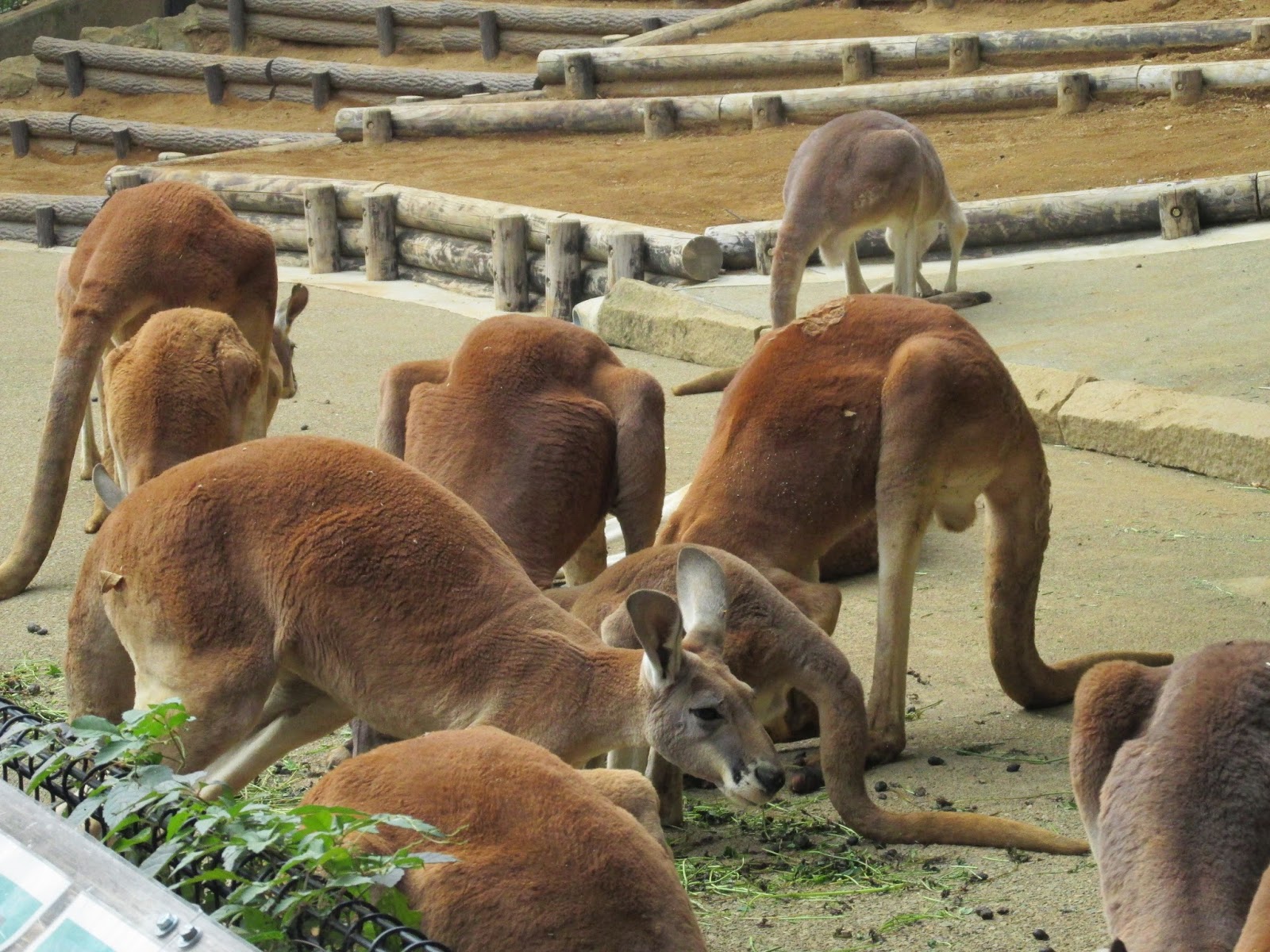
Main attraction in the Australian zone was the koala house. The koalas were a gift from the Australian government many years ago, and after reading the plaque at the front door explaining the gift, I was expecting a grand enclosure. However, the two koala bears were perched on bare trees, which were the only decoration in an otherwise concrete home. They seemed popular with the Japanese visitors, but the koala house wasn’t one I rated highly. Other animals in the Australian zone: laughing kookaburra, womat, wallaby, wallaroo and kangaroo.
The largest area in the park, as you might imagine, was the Asian zone. There was such a wide variety of animals, and plenty of star acts. One of our favourite things we saw were the snow leopards. They are an endangered species, and it’s rare to see them in the wild. The David Attenborough series Planet Earth showed some of the first ever footage taken of snow leopards in the wild, and that wasn’t until 2006. The Tama Zoo has three snow leopards, two together in one enclosure and one in another. The two together were quite a spectacle. For a while they were just lazing around, eating and drinking from the stream, but every so often they leapt into action with one pouncing on the other in an elaborate play-fight, chasing each other up and down the rock face and tumbling in the grass. Each time they moved the entire crowd gasped and oohed and ahhed. Their tails were magnificently thick, and they had large paws – a trait which helps them to grip in their natural snowy environment.
We passed by the orang-utan enclosure, which includes an ‘Orang-utan Skywalk’ for the creatures to swing overhead between their usual playground and the Orang-utan forest, though I get the feeling that this is seldom used. Certainly no primates went flying through the treetops as we were walking underneath.
Looking at the map, I was baffled by the obscurely named ‘Pere David’s Deer’ and wondered who this Pere David was, given that the nearby picnic area was also named after him. Pere David was a French missionary who worked in China in the 1800’s. He sent examples of the animals to France where the French biologist Alphonse Milne-Edwards named them after Pere David. This species of deer is native to the subtropics of China, and while there are a number in captivity, they have a conservation status of EW (Extinct in the Wild). Efforts have been made to conserve the dwindling population so they can be reintroduced in the wild, but first they had to be reintroduced to China in a captive capacity.
In Neolithic times, the animals ranged all over China proper in large numbers. By the late 19th century, the only herd of Pere David’s Deer in the world belonged to the Emperor of the time, Tongzhi. In 1895, a wall of the Royal Hunting Garden was destroyed in a heavy flood, and most of the animals escaped and were killed by the starving peasants. Then in the Boxer Rebellion of 1900, the remaining deer were shot and eaten, leaving the Pere David Deer extinct in its native China. The species was saved by Herbrand Russell, 11th Duke of Bedford. He acquired the few remaining animals from zoos across Europe and nurtured a herd at Woburn Abbey, from which the current world population now stems. As annual population of the captive deer continues to increase, it is hoped that one day the animals may be able to be reintroduced into the wild.
We saw a great number of other creatures in the Asian zone of Tama Zoo, such as the red panda, golden takin, chamois, wild horse, gray wolf, Japanese serow, mouflon, Himalayan tahr, greater one-horned rhinoceros, macaw, brown bear, Japanese giant flying squirrel and Japanese macaque. The macaques were funny creatures, with their bright red faces and bright red behinds they were comical from either end. They sat mostly in groups, grooming and playing together, with fights occasionally breaking out with piercing screams, the bearing of teeth and the defeated party scampering away with a wide-eyed look of fear.
That concludes our trip to the Tama Zoo in Tokyo. A grand day out indeed – I love zoos, and this one rates highly. Some of the enclosures lacked inspiration or didn’t seem very natural, but on the whole I felt that the Tama Zoo was animal-friendly, and the exhibits all seemed quite comfortable. It was a little busy when we visited but not heaving, and it was pleasant to see everyone having such a good time. The next big tourist spot on our list (hopefully) is the Imperial Palace…so until then, Sayonara.
P.S. A photo I took one our way to Japanese class last week – a praying mantis fighting with a worm.
Last weekend we went to Tama Zoo. There are three zoos in Tokyo, as well as a sea life park (which, like in China, is hugely expensive compared with the zoo entrance fee). We decided on Tama zoo as it looked the most interesting from the Tokyo-zoo website, and it was the closest to us – even closer than we’d first thought, actually, as it only took about half an hour or so to get there. Entrance price to the zoo is 600¥ (about £3.50) but we got a combined ticket for the Tama Monorail which cost 1,000¥ and included the monorail part of our travel there and back. It was fantastic value, and I noticed on the brochure that they offer free entrance to kids under 12, students who live in Tokyo and disabled people.
Tama Zoo is split into different areas – African zone, Australian zone, Asian zone and the Insectarium. We started off at Insectopia – a giant greenhouse shaped like a butterfly that houses locusts and Lepidoptera in their masses. It was a stunning place to begin our outing – that day was a little chilly out and stepping into the warm, humid conservatory was lovely indeed. In the main domed area, there were hundreds of butterflies flying around and weaving in and out of the planted areas. The cavernous enclosure gave them so much space to move around that my photographs can’t do justice to how many butterflies there were in there. Some sat placidly on the flaky paintwork of wooden frames that held up the vines of flowers, while others darted around energetically, teasing the camera as they appeared to pause on a leaf, then soaring off again before I had time to frame the shot. It was truly breath-taking, and made all the more magical as we’d come on a weekend; the room was filled with the sound of children shrieking in delight as papery wings tickled their skin and dazzling colours flickered before their eyes.
We had lunch in the ‘Insect Picnic Area’, surrounded by Japanese families who were consuming onigiri in prodigious quantities. After that, a quick tour of the Insectarium Centre which boasted a glow-worm cave and a series of tunnels stuffed with leaf-cutter ants, busy at work. There was a table in the ‘hands on’ area where you could pick up the insects for a closer look. A rather rotund Japanese boy made firm friends with a giant stick insect – the area was not staffed, and for a moment I thought he would put the insect in his pocket to take home with him.
From our buggy-beginning we proceeded through to the African zone. The crowning feature was the Lion enclosure, where you could pay extra to ride on the ‘lion bus’ and get up close to the animals. We decided against it and enjoyed the view from above. In the middle of the enclosure was a building that was inexplicably decorated to look like the Taj Mahal. The tarmac road that ran around the arena for the lion bus also looked out of place. The lions had a fair amount of space, but they didn’t look particularly happy; perhaps they were just lethargic after their morning meal. Also in the African zone were zebras, giraffes, servals, flamingos, three African elephants, ostriches and a couple of moody cheetahs.
On the way up to the Australian zone, we passed through an area that was populated mainly by different types of birds. There was a deep pit filled with Oriental white storks, an aviary of eagles, and a whole cage of different sorts of owl. Best of all was the Tawny Frogmouth owl - speckled fluff-balls which looked suspicious, quizzical and surprised. I couldn’t get a good picture through the bars of the cage, but here’s one I found on Google.
Main attraction in the Australian zone was the koala house. The koalas were a gift from the Australian government many years ago, and after reading the plaque at the front door explaining the gift, I was expecting a grand enclosure. However, the two koala bears were perched on bare trees, which were the only decoration in an otherwise concrete home. They seemed popular with the Japanese visitors, but the koala house wasn’t one I rated highly. Other animals in the Australian zone: laughing kookaburra, womat, wallaby, wallaroo and kangaroo.
The largest area in the park, as you might imagine, was the Asian zone. There was such a wide variety of animals, and plenty of star acts. One of our favourite things we saw were the snow leopards. They are an endangered species, and it’s rare to see them in the wild. The David Attenborough series Planet Earth showed some of the first ever footage taken of snow leopards in the wild, and that wasn’t until 2006. The Tama Zoo has three snow leopards, two together in one enclosure and one in another. The two together were quite a spectacle. For a while they were just lazing around, eating and drinking from the stream, but every so often they leapt into action with one pouncing on the other in an elaborate play-fight, chasing each other up and down the rock face and tumbling in the grass. Each time they moved the entire crowd gasped and oohed and ahhed. Their tails were magnificently thick, and they had large paws – a trait which helps them to grip in their natural snowy environment.
We passed by the orang-utan enclosure, which includes an ‘Orang-utan Skywalk’ for the creatures to swing overhead between their usual playground and the Orang-utan forest, though I get the feeling that this is seldom used. Certainly no primates went flying through the treetops as we were walking underneath.
Looking at the map, I was baffled by the obscurely named ‘Pere David’s Deer’ and wondered who this Pere David was, given that the nearby picnic area was also named after him. Pere David was a French missionary who worked in China in the 1800’s. He sent examples of the animals to France where the French biologist Alphonse Milne-Edwards named them after Pere David. This species of deer is native to the subtropics of China, and while there are a number in captivity, they have a conservation status of EW (Extinct in the Wild). Efforts have been made to conserve the dwindling population so they can be reintroduced in the wild, but first they had to be reintroduced to China in a captive capacity.
In Neolithic times, the animals ranged all over China proper in large numbers. By the late 19th century, the only herd of Pere David’s Deer in the world belonged to the Emperor of the time, Tongzhi. In 1895, a wall of the Royal Hunting Garden was destroyed in a heavy flood, and most of the animals escaped and were killed by the starving peasants. Then in the Boxer Rebellion of 1900, the remaining deer were shot and eaten, leaving the Pere David Deer extinct in its native China. The species was saved by Herbrand Russell, 11th Duke of Bedford. He acquired the few remaining animals from zoos across Europe and nurtured a herd at Woburn Abbey, from which the current world population now stems. As annual population of the captive deer continues to increase, it is hoped that one day the animals may be able to be reintroduced into the wild.
We saw a great number of other creatures in the Asian zone of Tama Zoo, such as the red panda, golden takin, chamois, wild horse, gray wolf, Japanese serow, mouflon, Himalayan tahr, greater one-horned rhinoceros, macaw, brown bear, Japanese giant flying squirrel and Japanese macaque. The macaques were funny creatures, with their bright red faces and bright red behinds they were comical from either end. They sat mostly in groups, grooming and playing together, with fights occasionally breaking out with piercing screams, the bearing of teeth and the defeated party scampering away with a wide-eyed look of fear.
That concludes our trip to the Tama Zoo in Tokyo. A grand day out indeed – I love zoos, and this one rates highly. Some of the enclosures lacked inspiration or didn’t seem very natural, but on the whole I felt that the Tama Zoo was animal-friendly, and the exhibits all seemed quite comfortable. It was a little busy when we visited but not heaving, and it was pleasant to see everyone having such a good time. The next big tourist spot on our list (hopefully) is the Imperial Palace…so until then, Sayonara.
P.S. A photo I took one our way to Japanese class last week – a praying mantis fighting with a worm.
Subscribe to:
Posts (Atom)